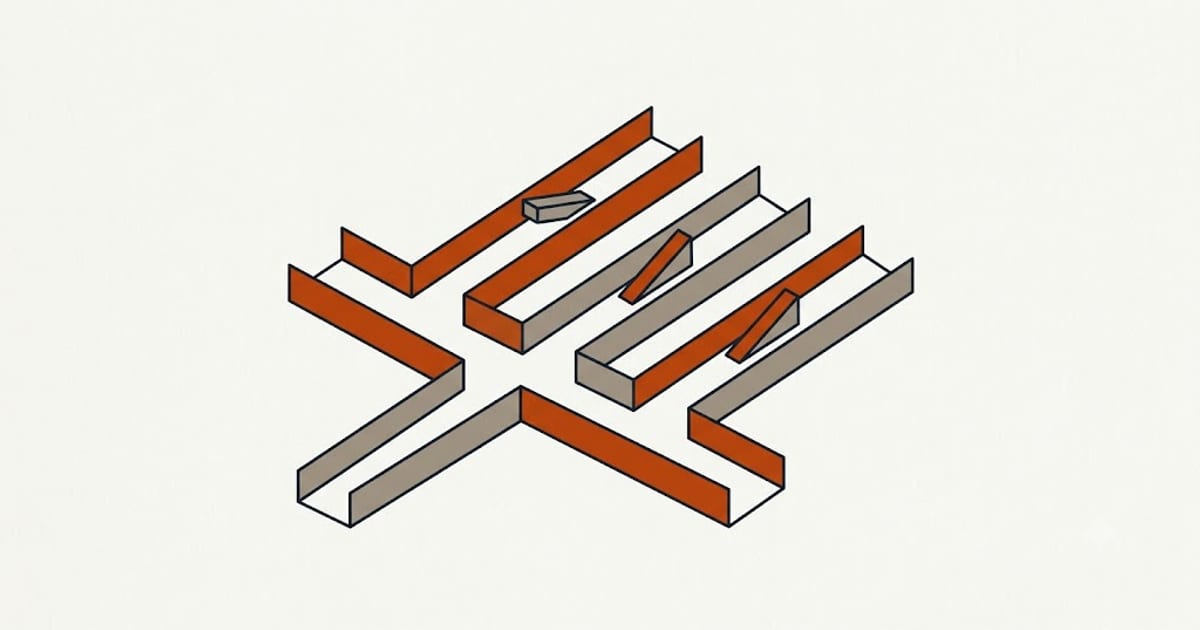
A duct system delivers air where it is easiest, which is to the nearest, largest, straightest branches. Balancing restores the intended distribution.
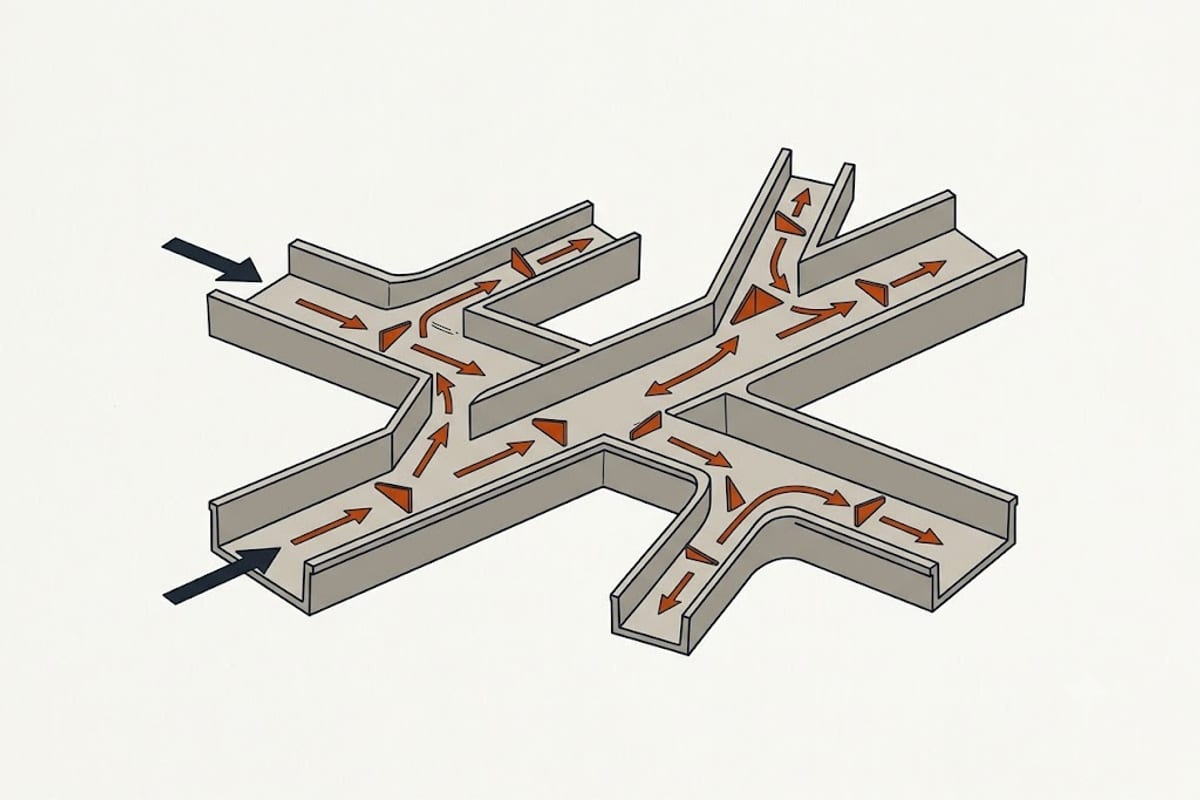
Where dampers belong
At the takeoff, where each branch leaves the trunk. That is where a restriction does the least harm: it diverts air to the other branches rather than fighting the blower at the end of the line.
A damper at the branch is part of the design. A closed register at the room is a restriction at the wrong end of it.
Why closing registers is not balancing
Closing a register raises the pressure in that branch and in the trunk, which raises total system static pressure.
Higher static pressure means the blower moves less total air, so the rooms that were already short get less. Closing vents in unused rooms does not redirect their air usefully; it reduces the amount of air the system moves overall.
It also raises the risk of a frozen coil in cooling and a high-limit trip in heating, both of which come from low airflow across the equipment.
Doing it properly
Start with the calculated CFM for each room, from a room-by-room load calculation. Without that target, balancing is guesswork.
Measure what each register actually delivers, with a flow hood.
Adjust the branch dampers, working from the rooms with too much toward the rooms with too little, and re-measure. It is iterative, because every adjustment changes every other branch.
Mark and record the final positions, so a damper knocked in an attic can be restored.
The seasonal complication
Heating and cooling do not want the same distribution.
Cooling favours the rooms with solar gain and upper floors; heating favours the rooms with the most exterior surface. A system sized for the larger of the two requirements per room and then balanced can be adjusted between seasons if the dampers are accessible and marked.
Most houses set them once, for cooling, which is the more demanding case in most climates.
What balancing cannot fix
Insufficient total airflow. If the system is delivering 900 CFM when it should deliver 1,200, balancing redistributes a shortage. The fix is the static pressure problem behind it.
A branch that is too small. A damper can only reduce flow, never increase it. A branch already short at fully open needs to be larger, not adjusted.
A room with no return path, which will not accept its supply air with the door closed however open the damper is.
Balancing is the last step, after the duct system is capable of delivering the air.
Where dampers are missing
Many existing systems have none. Retrofitting them at accessible takeoffs is straightforward where the ducts can be reached, and impossible where they cannot.
Where dampers cannot be fitted, the alternatives are adjusting at the register — accepting the penalty above — or resizing the branch.
Zone dampers are a different thing
Motorised dampers that open and close in response to a thermostat are a zoning system, not balancing.
They introduce their own problem: when one zone closes, the blower is pushing full airflow into a fraction of the duct system. Without a bypass or, better, variable-capacity equipment able to turn down, static pressure rises sharply.
Balancing dampers are set once and left; zone dampers move constantly, and the system has to be designed for that.
The record worth keeping
A table of rooms, calculated CFM, measured CFM and final damper positions.
It takes one page, it is the evidence that the system was commissioned, and it is what makes any future complaint diagnosable rather than a matter of opinion.