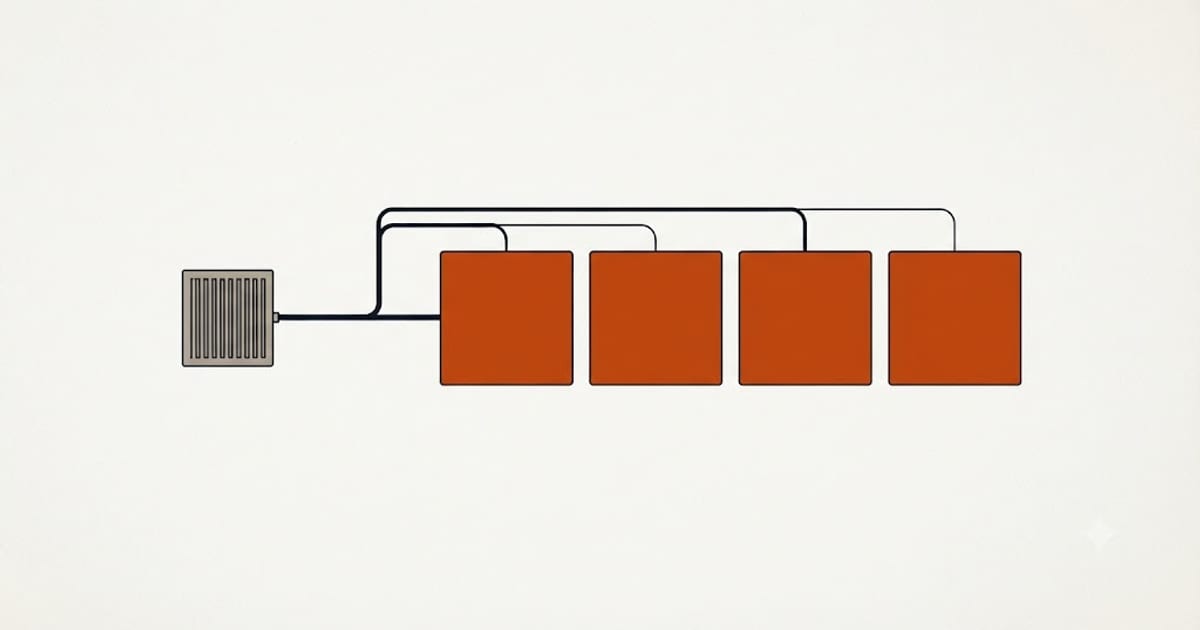
A blower moves a fixed volume of air in a loop. It can only push into the house what it can pull out of it, and in most homes the return side is where the design was compromised — because a homeowner complains about a supply register that blows weakly, and nobody has ever complained about a return grille.
The result is systems that are strangled on the intake, diagnosed on the outlet, and remedied in the wrong place.
The quick check: grille area
The rule of thumb used in the trade is roughly 1 square foot of net free area per 400 CFM, and around 400 CFM per ton of cooling. Return grilles are commonly sized for a face velocity of 300 to 500 feet per minute; above that they whistle.
| System | Airflow | Net free return area needed |
|---|---|---|
| 2 ton | ~800 CFM | ~2.0 ft² |
| 2.5 ton | ~1,000 CFM | ~2.5 ft² |
| 3 ton | ~1,200 CFM | ~3.0 ft² |
| 4 ton | ~1,600 CFM | ~4.0 ft² |
| 5 ton | ~2,000 CFM | ~5.0 ft² |
Net free area is not the size of the hole. A grille's louvres block a substantial share of it — commonly 25% or more. A 20×25 inch grille measures 3.5 ft² and delivers around 2.6 ft² of free area. Filter grilles with a filter in them are worse again.
Measure the grilles you have, subtract for the louvres, and compare against the table. A three-ton system on a single 20×25 return is short, and a great many houses are built exactly that way.
The measurement that proves it
Static pressure, taken either side of the air handler. If the return side dominates the total — more of the pressure drop is happening before the blower than after it — the return is the constraint, whatever the supply looks like.
This is the ordinary finding. Most systems measured this way are return-starved, and it explains a set of symptoms that get blamed on other things:
- rooms that never keep up despite open registers,
- a coil that freezes in cooling,
- a system noticeably louder than it used to be,
- and higher bills with nothing visibly wrong.
The closed-door test
Close every interior door in the house with the system running, then open them all. If the system gets quieter and the rooms improve with the doors open, you have a return path problem.
A bedroom with a supply register and a closed door has nowhere for air to go. Pressure builds until the incoming air is fighting the pressure it created, and delivery to that room collapses — at night, which is exactly when it matters.
Door undercuts are the usual provision and they are usually inadequate. A half-inch undercut on a standard door passes on the order of 50 CFM; a bedroom taking 150 CFM needs three times that.
What actually fixes it
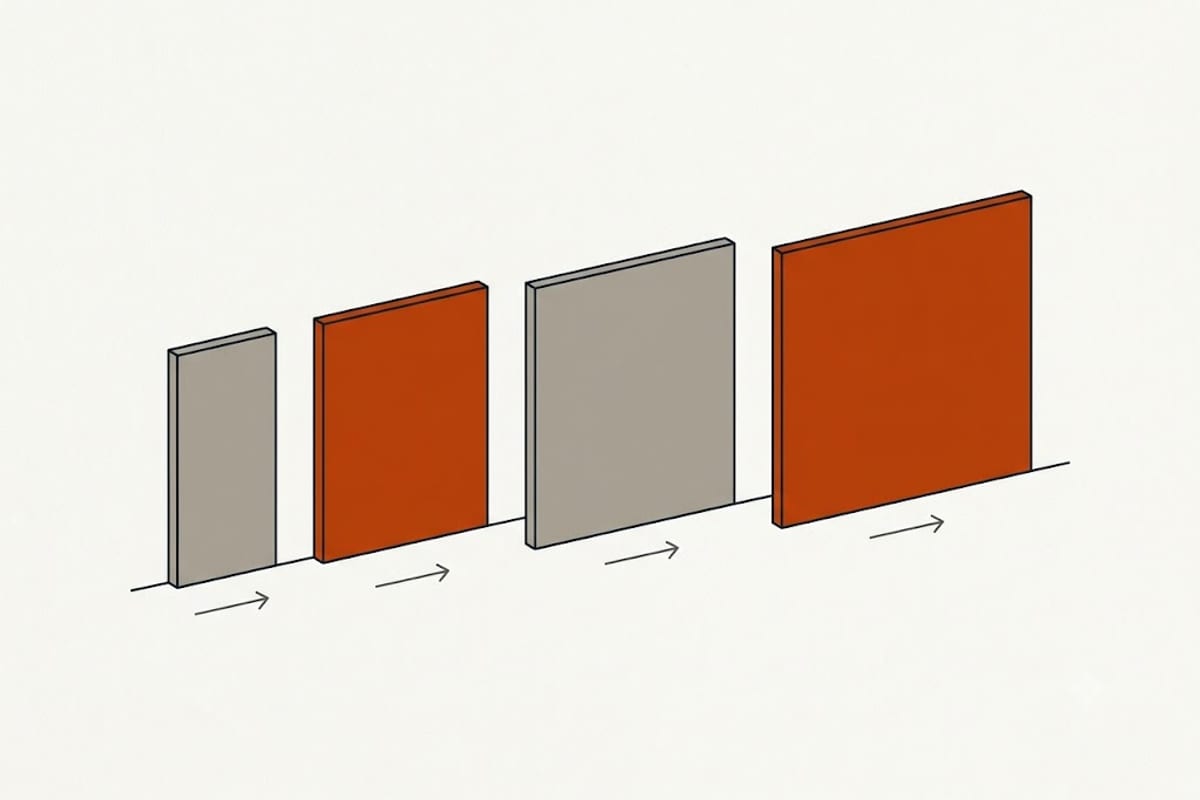
Add return area. A second central return, or returns in the rooms that need them. This is the real fix and it is the most disruptive.
Transfer grilles or jumper ducts. Where a full return is impractical, a grille through the wall above the door, or a short duct looping through the ceiling between the room and the hallway, gives air a path without carrying sound straight through. Both are far less work than a new return run.
Undercut the doors properly. Cheapest, least effective, and better than nothing.
Fix the filter while you are there. A 1-inch MERV 13 costs around 0.45 in w.c. on its own — most of the whole system's budget. A 4-inch media cabinet does the same filtration job at about 0.15, because more area means lower velocity. On a return-starved system this single change often recovers more than anything else on the list.
What does not fix it
Closing supply registers elsewhere. It raises system pressure, which reduces total airflow and increases duct leakage. The room you were trying to help typically gets slightly worse.
Turning the blower up. More noise, more power, same restriction.
A bigger system. More tonnage needs more airflow, and the return that could not feed the old one certainly cannot feed a larger one. Replacing equipment without touching an undersized return is how a new system ends up performing worse than the one it replaced — which is a genuinely common outcome and a very expensive one.