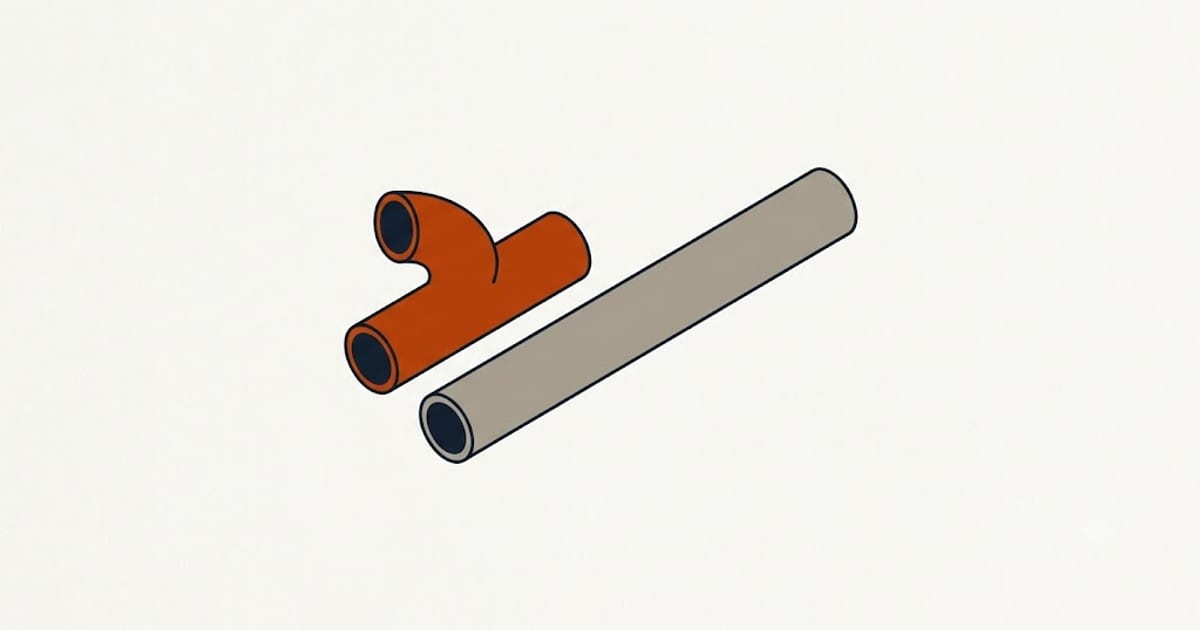
Air loses pressure travelling through straight duct, and it loses considerably more turning corners, entering branches and leaving through boots.
The idea
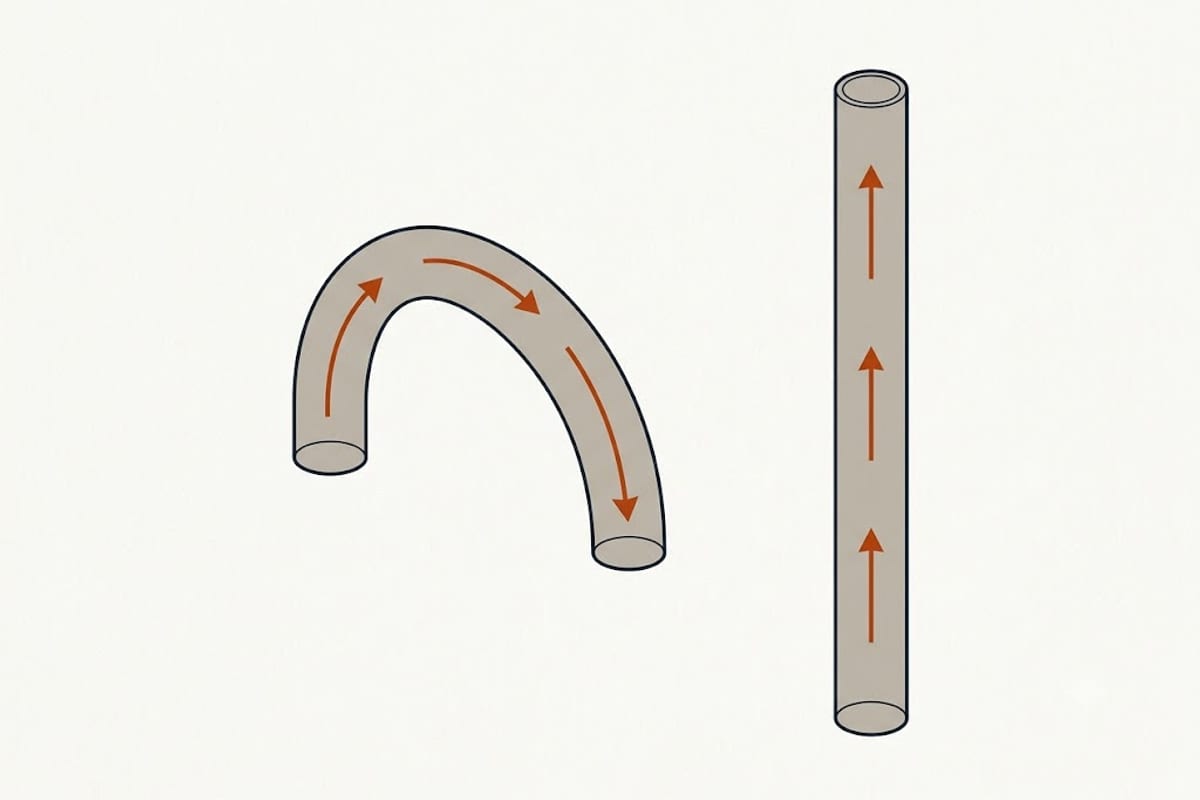
Rather than calculate each fitting's loss separately, duct design expresses every fitting as the length of straight duct that would produce the same pressure drop.
That is its equivalent length, and ACCA Manual D publishes tables of them by fitting type and size.
total effective length = measured straight duct + sum of fitting equivalent lengths
The magnitudes
The values are larger than intuition suggests. Depending on type and size:
A sharp elbow can be worth tens of feet of straight duct. A smooth long-radius elbow is worth far less, which is the whole argument for using them.
A takeoff from a trunk is worth a substantial length, and a properly designed conical or bellmouth takeoff much less than a bare stub.
A boot at the register, and the register or grille itself, each contribute.
A flex duct bend is worth more than a metal one, and a tight one much more.
The practical result: a run with a measured length of 30 feet and half a dozen fittings can have a total effective length of 150 to 250 feet.
Why it decides the duct size
Friction rate — the pressure the design allows per 100 feet — is calculated by dividing the available static pressure by the total effective length of the longest run.
friction rate = (available static pressure × 100) ÷ total effective length
A long effective length forces a low friction rate, which forces larger ducts. Sizing from measured length alone gives a friction rate that is far too generous and ducts that are far too small.
This is the single most common technical error in residential duct design, and it is invisible until somebody puts a manometer on the system.
The fittings worth spending money on
Long-radius elbows instead of sharp ones, wherever there is room.
Conical or bellmouth takeoffs at the trunk instead of a bare stub, which is a small extra cost per branch and a large reduction in loss.
Turning vanes in rectangular elbows.
Gradual transitions at the equipment instead of an abrupt reducer from the plenum.
Boots with a gradual transition rather than a square box behind the register.
None of these changes the duct diameter and together they can transform a system's static pressure.
Counting them on an existing system
Walk the longest run and count: elbows, takeoffs, transitions, the boot, the register.
If the run is long and the count is high, and the ducts look small, the system was probably sized on measured length — and the static pressure measurement will confirm it in five minutes.
Where the design can shorten the run
The longest run is what sets the friction rate for the whole system, so shortening it helps everything.
Move the equipment closer to the centre of the house, where possible.
Use two trunks in opposite directions rather than one long one.
Reduce the number of fittings in the worst run, even by one or two.
This is why a system designed around the equipment's location performs better than one where the equipment went wherever there was space.
Return fittings count too
Equivalent length applies on the return side exactly as it does on the supply, and the return side is where it is most often ignored.
A return grille, a filter, a boot and two elbows on the way to the equipment are all losses, and they are part of the total the blower has to overcome. A design that carefully accounts for supply fittings and treats the return as "whatever gets it back" produces the pattern found in most existing houses: adequate supply ductwork and a return that is the actual restriction.
Why this is not visible from inside the house
Nothing about a high effective length can be seen from a register.
The room simply gets less air than it should, which is described as a duct problem, a balance problem, or an undersized system — and the first two are right while the third is the one usually acted on.
A manometer resolves it, and it is the reason the static pressure reading is worth more than any other single diagnostic on a duct system.