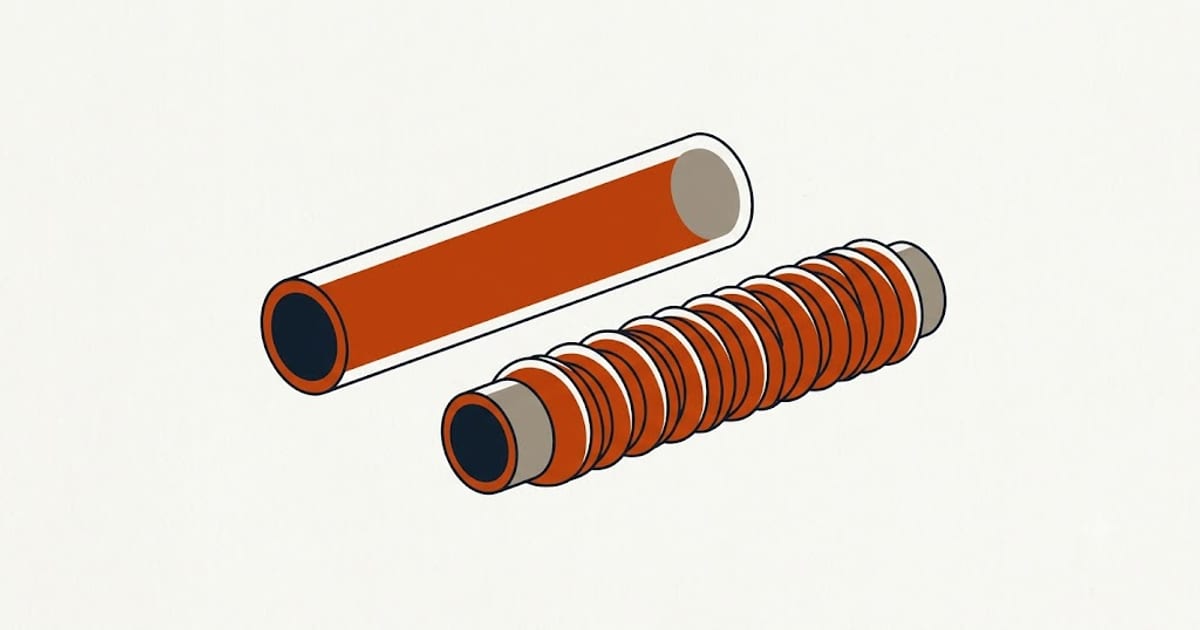
Flexible duct is a wire helix with a plastic inner liner, wrapped in insulation and an outer jacket. Rigid duct is smooth sheet metal. They do not behave the same.
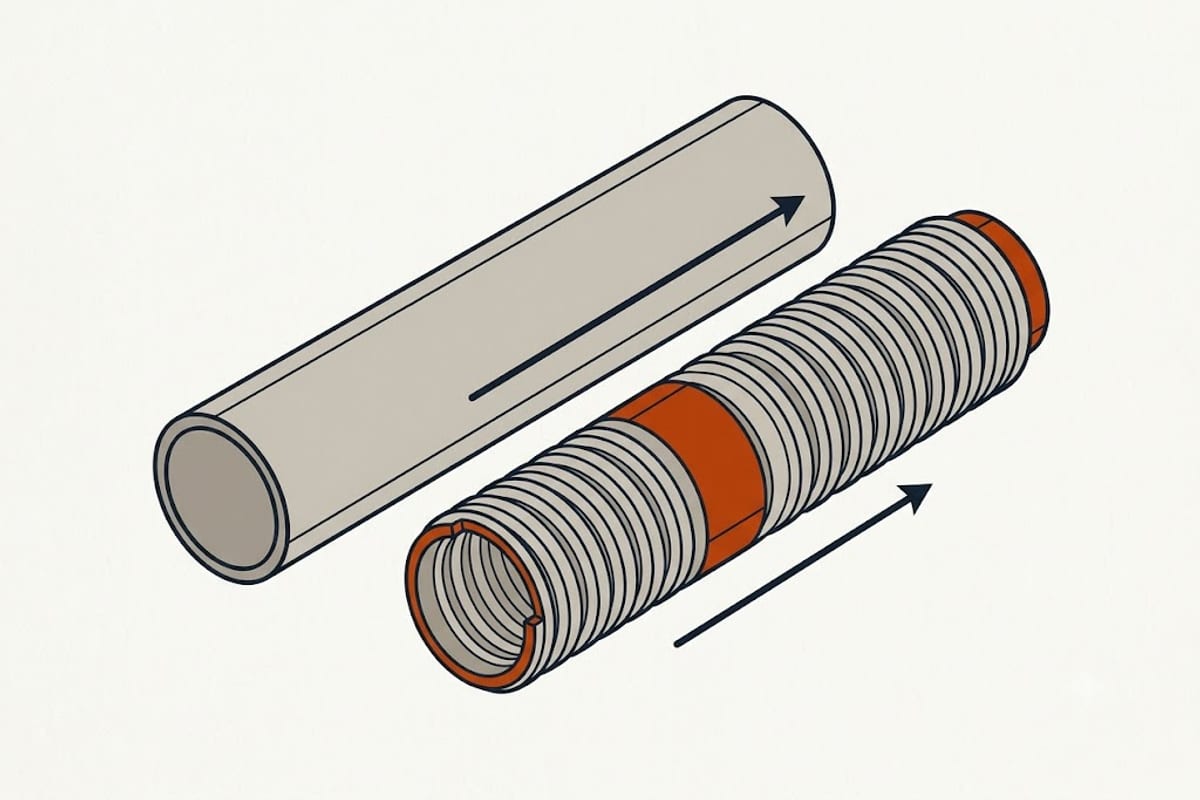
The friction difference
The corrugated inner liner of flex duct disturbs the airflow along its whole length, and the pressure drop per foot is considerably higher than smooth metal of the same diameter.
Design tables list them separately for exactly this reason. Sizing flex from a rigid-duct chart undersizes it, and the result is a system carrying less air than the design intended.
Compression makes it much worse
The published performance of flex duct assumes it is fully stretched.
Left slack, the liner corrugates more deeply and the effective cross-section falls. Published research on compressed flex shows very large capacity losses — a duct compressed by even a modest percentage of its length can lose a substantial share of its airflow.
In a typical attic installation, flex is cut generously, laid loose, and allowed to sag between supports. Every sag is a restriction.
The failure modes specific to flex
Slack runs, as above.
Sharp bends, which can nearly close the duct. Manufacturers specify a minimum bend radius and it is routinely ignored.
Kinks at the boot, where the duct turns down into a ceiling register in a tight space.
Unsupported spans, which sag between supports. Support at close intervals with wide straps rather than wire, which cuts into the jacket and pinches the liner.
Compression against framing, where the duct is squeezed past a truss.
Long runs, where the accumulated friction is large and where nobody wants to cut and rejoin.
Where flex is fine
Short branch runs from a rigid trunk to a boot, fully stretched, properly supported, with gentle bends. This is what it is designed for and it works well.
Where a small amount of flexibility solves a real problem, such as the last few feet to a register in an awkward position.
Vibration isolation at the equipment connection.
Where rigid is worth the money
Trunk lines, always. The main runs carry the most air and the friction penalty is largest there.
Long runs of any kind.
Anywhere the duct will be inaccessible after construction, since a compressed flex run in a closed ceiling cannot be corrected.
Where static pressure is already tight and there is no margin to give away.
The compromise most good systems use
Rigid metal trunk, sealed and insulated, with short fully-stretched flex branches to each boot.
It costs more than all-flex and considerably less than all-rigid, and it puts the smooth duct where the air volume is highest.
Inspecting an existing system
Go into the attic or crawl and look at the flex.
Is it taut, or does it curve and sag? Slack is capacity lost.
Are the bends gentle? A right-angle bend in flex is a major restriction.
Is it supported at close intervals with wide straps? Wire ties and long spans are both problems.
Is anything crushed where it passes framing or under stored items?
Pulling the slack out of a run and re-supporting it costs nothing but time and can meaningfully improve a room that has always been short.
Insulation and vapour
Flex comes with insulation and an outer vapour jacket. In a humid attic that jacket has to be intact and sealed at every connection, or moisture condenses on the cold liner inside the insulation.
A torn jacket in a hot humid attic produces wet insulation, dripping ducts, and eventually a ceiling stain that gets blamed on the roof.