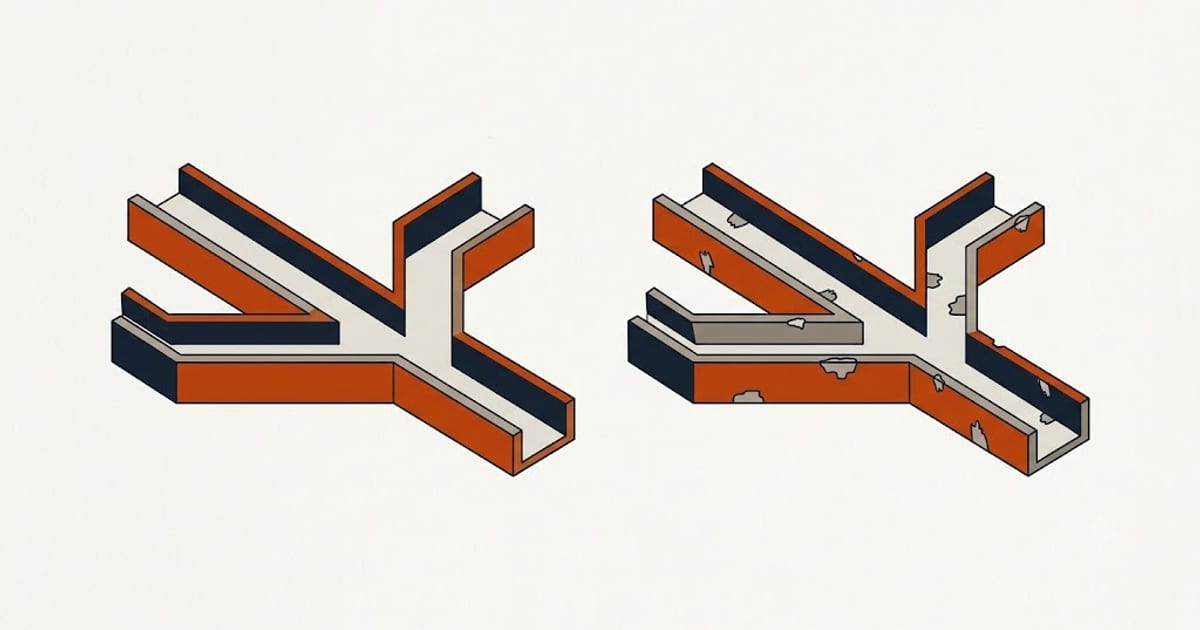
Duct replacement is disruptive and expensive, and it is proposed more often than it is warranted.
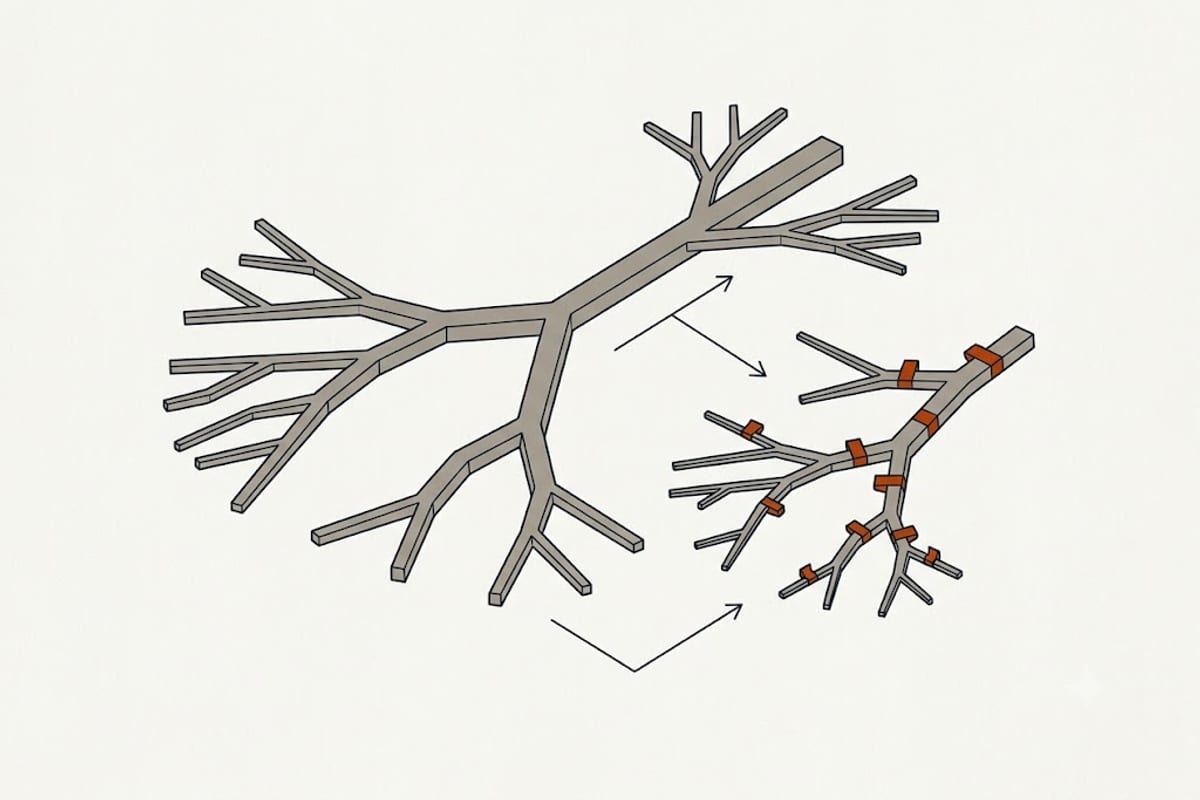
What repair recovers
Sealing addresses leakage, which is commonly 20–30% of system airflow in an unsealed house. This is the largest single recoverable loss and it does not require replacing anything.
Re-supporting and stretching flex recovers capacity lost to sag and compression.
Correcting the worst fittings — a sharp elbow at the plenum, a bare stub takeoff — lowers static pressure meaningfully for a small cost.
Adding return area and filter area raises airflow to every register.
Insulating what is bare reduces conduction in an attic or crawl.
Together these frequently take a system from delivering two thirds of its rated airflow to delivering nearly all of it, at a fraction of replacement cost.
When replacement is the right answer
The ducts are genuinely undersized for the equipment, confirmed by a static pressure measurement well above design that sealing and return work do not bring down.
Panned joists or stud cavities are used as ducts, which cannot be made airtight and which connect the system to the framing and often to the attic.
Ductboard that has deteriorated, with the inner surface eroding into the airstream.
Flex that has collapsed or been crushed over long inaccessible runs.
A layout that cannot deliver — a system with no branch to a room that needs one, or a single trunk running the length of a house.
Contamination after a fire, flood or long-term moisture problem, where cleaning is not practical.
The measurement that decides it
Static pressure first. Then duct leakage. Then airflow at the registers against the calculated requirement.
Those three numbers say whether the problem is leakage, restriction, or capacity, and only the third argues for replacement.
Deciding without them means paying for a replacement that a day of sealing would have made unnecessary — or sealing a system that was never large enough.
The moment that makes replacement cheap
During a major renovation, when ceilings are open.
During a system replacement, when the plenum is off and the equipment is out.
When an attic is being re-insulated, since access is already arranged.
Outside those moments the access is most of the cost, which is why partial replacement of the worst runs is frequently the sensible middle course.
Old ducts and what may be in them
Duct systems in houses built before the late 1970s can contain asbestos, typically in tape or insulation wrapped around the exterior of the duct, and occasionally in the duct material itself.
It is not disturbed by normal operation and it must not be disturbed by work on the ducts. Where a house of that age is having duct work done, testing before the work starts is the correct sequence, and abatement is a licensed trade.
The same era can also have ducts lined internally with materials that deteriorate. A visual inspection with a camera answers it.
The order for a house with problems
Measure. Seal. Add return and filter area. Re-support and stretch. Measure again.
If the numbers are still wrong after that, the case for replacing specific runs is now evidence-based, and it will usually be a few runs rather than the whole system.
Cleaning is a different question
Duct cleaning is frequently sold alongside repair and it addresses neither leakage nor restriction.
It is worth doing after construction work, after a rodent problem, or where there is visible contamination. It is not a performance improvement, and a system with a dirty coil and blower wheel benefits far more from cleaning those two components than from having the ducts vacuumed.
Be wary of an offer that combines cleaning with a free inspection and returns with photographs of a problem. Ask for the static pressure and leakage numbers instead.
Partial replacement is normal
Replacing the trunk while keeping the branches, or replacing three bad runs and sealing the rest, is a legitimate and common answer.
Framing the decision as all-or-nothing usually favours the more expensive option, and the measurements above will generally point at specific runs rather than at the whole system.